|
www.chucksfalconry.com (redirects to
http://virtualvideo.cc/falconry)
Falconry in Houston, TX
DSL or Cable Internet Highly
Recommended - Many Pictures
Click
On These Other Links Within This Website:
|
Cisco in the press
Text of Joey Richard's Article in
Galveston Daily News Cisco
Killer King
PDF's of Same Article Killer
King PDF's
Houston Chronicle Article on Jim Ince and Gaucho, with brief reference
to Cisco Chronicle
Picture of Cisco, 2nd Honorable Mention in Western Sporting / L.L.
Electronics' Photo Contest (download if necessary) Photo
Contest
Same picture employed in Western Sporting ad: Sporting
Cover of Texas Parks and Wildlife Magazine, Nov, 2008. Cover
There were a number of pictures of him (taken by Kendall Larsen) in the
article, but without attribution
|

"Alex",
my first bird after
three decades, a passage female American kestrel, two days before she
was attacked and driven off by a female sharp-shin hawk.
Photo: Russell Bryant on 12/29/2004 |

"Apollo", Haggard Tiercel
American Kestrel - He was lost April 25, 2005, after taking his first
sparrow, staying out overnight, catching a lizard, and finally escaping
my trap
Photo:
Stephanie Redding on
2/11/2005
|
|
|

"Bravo",
passage tiercel redtail hawk, in his mew, taken early November 2005, a
few weeks before he flew off.
Photo: Chuck Redding
|

"Cisco",
passage tiercel redtail hawk with the first rabbit of the day, March
11, 2006, Ft Worth, TX at the "Texas Outlaw Dirt-Hawkers First Annual
Game Cookout and Mini-Meet"
Photo: Krys Langevin
|
|
|

Dart, a captive bred Harris' hawk.
A refugee of Hurricane Ike, he was given to me by Chris
Comeaux after Chris sustained heavy damage to his house on Bolivar
Peninsula
|

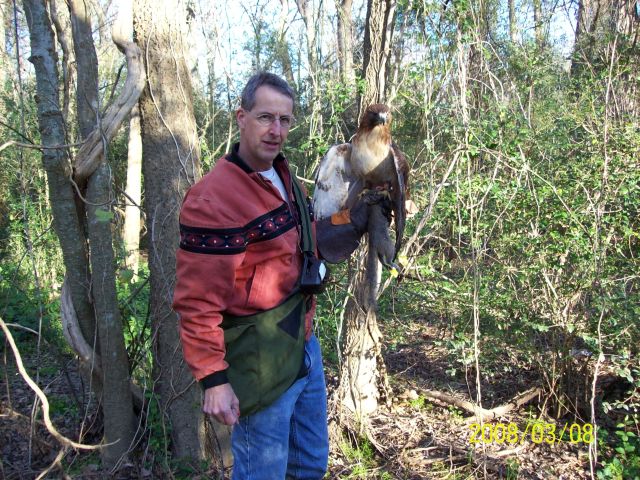
Cisco, March 8, 2008.
The capture of this squirrel demonstrates Cisco's capacity and
versatility. The squirrel was hidden from the hawk on that
little tree behind me. The hawk flew between the gap at
about shoulder level, snatching the squirrel from the back
side of the tree as he went through.
Photo by Mike Wiegel
|
For me this says it pretty well:
"The reward that comes from
practicing falconry is, and has to be, a feeling of your own personal
satisfaction; that, and that alone. Chances are no one else will be
around when your hawk is at her best. Falconry is a tedious, time
consuming effort with long periods of stress and anxiety punctuated by
heartbeats of gut-wrenching visceral satisfaction so intense that is
impossible to put into words."
Lifted from The California Hawking Club Apprenticeship Manual
|
And this:
"There are a hundred things that can happen in falconry, and only two
of them are good."
Overheard of Lisa Cherry at NAFA meet in Amarillo, TX - November 2008 |
|
|
On
the last
day of 2004, my passage kestrel (Alex) got driven off by a
sharp-shinned hawk, so I decided to build this web site.
A little background. After being away from falconry for over 35 years I
decided to return to it. As a kid I had trained a couple of
red-tail hawks, and fooled around some with American kestrels. Through an
old friend and falconer, Mark Reindel, who lives up
on the east coast, I met Jim
Ince, a master falconer living in Bellaire, Texas, who agreed to be my
sponsor. Required because of state and federal regulations, a sponsor can be
invaluable as a mentor, especially
for a novice . I accompanied Jim a few times while he hunted with his
tiercel peregrine. At some point he mentioned that folks were having
real success hunting birds with American kestrels, and that a friend of
his had written a treatise on the subject*. That was probably the
catalyst. At that point I started back into it. I learned about the
regulations, passed the written test, and acquired the necessary
equipment. I had the hawk house ("mews") built, and then had it inspected
by game wardens from Texas Parks and Wildlife, another requirement.
After paying the fees, I obtained the state and federal government
falconry permits. With some input from my sponsor, I built a bal-chatri
hawk trap, basically a small cage with a bait animal inside and fishing
line slip nooses on the top. This activity took a fair amount of time
and energy starting in the spring of 2004.
I trapped the juvenile kestrel, "Alex," late in the day on October 10,
2004. I had
previously caught and released two adult female kestrels, but was
trying to catch a juvenile bird. She was
trapped southwest of Rosenberg, TX, where she was flying around with
three or four other kestrels, possibly family members. They put on
quite an aerial display for about an hour before this juvenile female
hit the trap, just before I was about to leave and regroup for the
following weekend. Jim Ince was a little surprised when I showed up at
his house with an unhooded bird in the box. "What? You didn't hood
her?" If I had four hands I could have hooded her, but as it was, I
barely got her off the trap. First, my car was on the wrong side of the
road. Because of the way I held her, she had a
great opportunity to bite my thumb off. I was
holding the trap in one hand, bird in the other and I couldn't locate
my cutters to snip the unrelaxed nooses holding her leg. Then some guy
drove by and yelled at me, telling me I was breaking the law. So I just
stuffed the bird into the shoe box, figuring that Jim would figure out
a way of getting her out of there, which he did. He got her out of the
box using a dark room and a flash light. He hooded her, put jesses on
her and then unhooded her. She turned out to be an agreeable bird,
eating on Jim's fist within minutes.
Named after a tiercel eyas kestrel that I had as a kid, within a day
she was flying to my fist, and was a hit with everybody. She was flying
free in a few weeks, but encountered accipiters (sharp-shinned and
Cooper's hawks) regularly. On two occasions she was attacked by
Cooper's hawks in the air but did not seem overly upset. In fact she
chased the first one after I drove it off. On another occasion, at a
nearby park, a small sharp-shinned hawk attacked her and she turned on
it. The two birds met in mid-air, I yelled, and the sharpie headed off.
During her short falconry career she killed a couple of house sparrows,
and was on the verge of really hunting. On the morning of 12/31, just
two days after the picture above was taken, she was sitting in a tree
on our street in north Houston. She started her shrill alarm call
"kek-kek-kek," then she flew from the branch. I knew there must be a
hawk nearby. A female sharp-shinned hawk appeared from across the
street, high in the air, speeding like a bullet toward her. Alex headed
north with the sharpie right on her tail, and that was it. For a few
days, I spent a lot of time looking, but saw no sign of her. I didn't
completely give up looking for a couple of weeks. If she survived the
attack, she was apparently driven a long way off.
///////////////////////////////////////////////////////////////////////////////////////////////////////////////////////////////////////////////////////////////////////////////////////////////////////////
Notes added 7/26/2008
Here are a few more comments about Alex. I was thinking about
her today, nearly four years later. On the day that I lost
her, I was flying her in Oak Forest, a wooded, very large neighborhood
just north of downtown Houston. She pursued some sparrows up
to a martin house, and tried aggressively footing inside the entrance
holes. The sparrows stayed well back, as she failed to catch
any. On another outing, about a week earlier she flew from a
tree, crossing the street and flying into a bush where a sparrow was
hiding. She looked like a tiny redtail, gliding down with a
fixed wing triangular shape, and disappeared into the bush. A
great flight. It was momentarily quiet, she wasn't screaming,
and I was excited thinking that she had scored. But a few
seconds later, she began to scream, and I knew she had
missed. Her best
flight, a week or two earlier than that, was on a bagged sparrow that
she pursued from a tall light pole in the park. The sparrow
took off in a flash, heading for trees, and it looked as if the kestrel
had no chance. But she rolled over as it flew under her; she
then flew it down and pounded it into the ground. As she
settled in, a dog scared her, and she carried it. I lost her
for a very long hour or so, but she came back, and I took her
home. She had only gained fives grams in weight, so
apparently she lost the sparrow. Probably she was robbed by a crow, or
just dropped it, which I have seen kestrels do on ocassion.
When I got home, I called Jim Ince and talked excitedly about the
chase.
I need to
mention that Alex was the worst screaming bird that I have ever
encountered. Matt Mullenix attributed it to isolation, and I
now concur. She and Apollo, her successor, were both tethered
in the mew in the back yard, and though I spent a good part of each
evening with the birds, they were left completely alone during the day;
both screamed. Alex was worse. Her screaming was nearly
constant, except when she was hunting. On the fist, or if
anyone was around, it was constant. The minute I left her
alone she would be quiet, but when she would hear someone approaching,
it would start in again.
////////////////////////////////////////////////////////////////////////////////////////////////////////////////////////////////////////////////////////////////////////////////////////////////////////////////////////////////
*American
Kestrels in Modern Falconry, by Matthew Mullenix
Chuck Redding
Houston, TX
Please write me if you find typos or errors, whether grammatical, or
factual, or even just to let me know that you enjoy the site.
Email: cisco@virtualvideo.cc
After training another kestrel,
who caught his first game, and took off the same evening, I decided to
fly redtails. I lost the first redtail, called Bravo, in a bizarre
incident right after he was trained. As of this writing
(8/23/2008), I am flying a tiercel RT, called Cisco, about to start his
fourth season. Trapped in Ft. Worth late in 2005, he's a good rabbit
and squirrel hawk, well mannered, and entertaining to fly. Redtail and Harris' hawk
may be viewed live, sitting on their perches (typically 0600 to 1830 CST) at: http://cisco.webhop.org http://cisco.webhop.org:443

Visitors to this Site. Thank you.
|